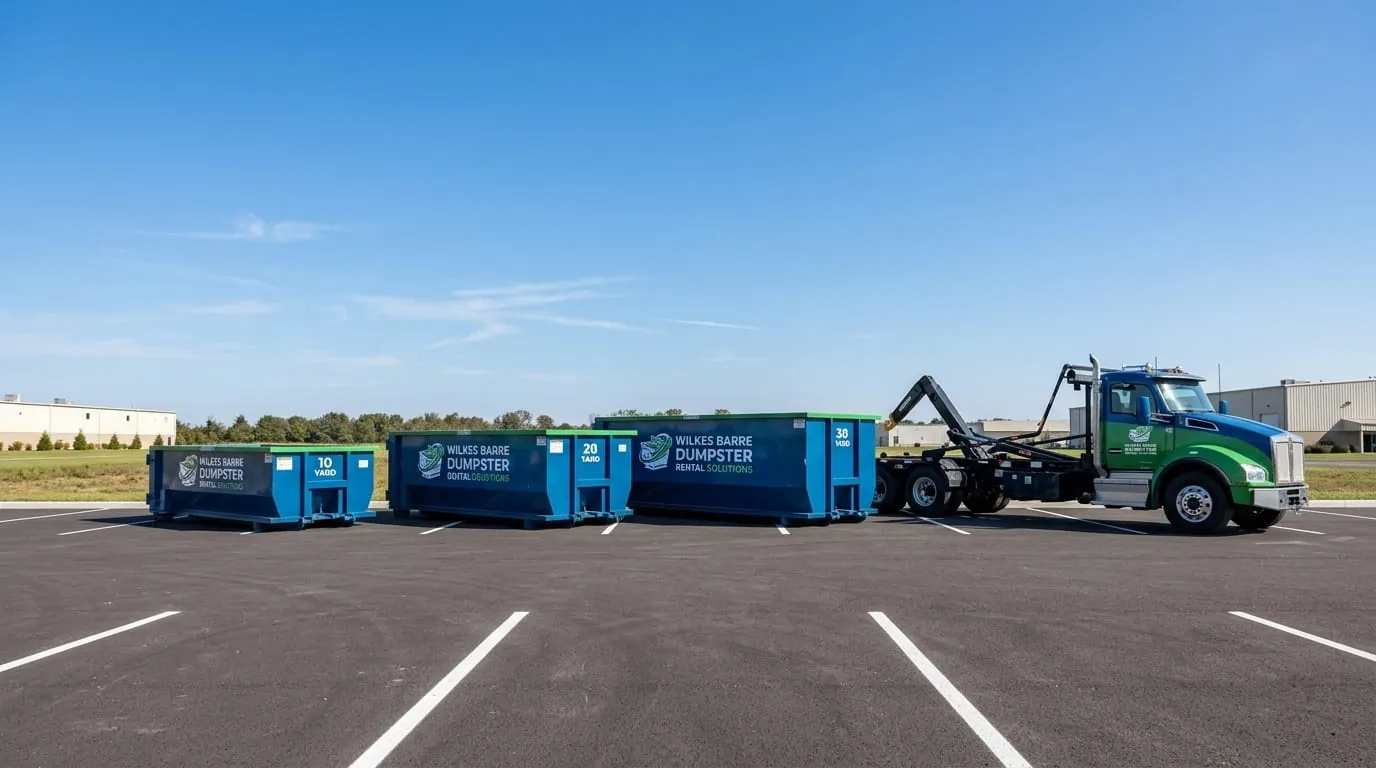
If you've never rented a roll-off before, standing in your driveway trying to guess how much junk a project will produce feels a little like guessing how many jelly beans are in the jar. Rent too small and you're calling for a second haul mid-project. Rent too big and you've paid for air. Here in Wilkes-Barre and across Luzerne County, we talk homeowners through this every single day, so let's take the guesswork out of it.
This guide walks through the four sizes we run most often, 10, 15, 20, and 30 yards, what each one actually holds, and which projects they fit best. We'll also cover the one thing most online guides skip: weight. Because a dumpster full of drywall and a dumpster full of concrete are two very different animals.
First, What Does "Yard" Even Mean?
When we say a "10-yard" or "20-yard" dumpster, we're talking about cubic yards of volume, not the length of the container. One cubic yard is a 3ft x 3ft x 3ft cube, roughly the size of a standard washing machine. So a 10-yard dumpster holds about ten of those cubes' worth of material.
To make it more real: one cubic yard is roughly what fits in the bed of a standard pickup truck, loaded level. So a 10-yard bin is about three or four pickup loads, and a 30-yard bin is around nine or ten. Keep that pickup-truck picture in your head and sizing gets a lot easier.
The Quick-Reference Size Chart
Here's the at-a-glance version. Dimensions vary slightly by container, but these are typical for the roll-offs we drop across the Wyoming Valley.
| Size | Typical Dimensions (L x W x H) | Holds (Pickup Loads) | Best For |
|---|---|---|---|
| 10-Yard | 12ft x 8ft x 3.5ft | ~3-4 loads | Single-room cleanouts, small bathroom remodels, heavy debris (concrete, dirt, roofing) |
| 15-Yard | 14ft x 8ft x 4ft | ~4-6 loads | Larger bathroom or small kitchen remodels, garage cleanouts, mid-size roofing |
| 20-Yard | 22ft x 8ft x 4.5ft | ~6-8 loads | Kitchen remodels, basement cleanouts, flooring tear-outs, larger decks |
| 30-Yard | 22ft x 8ft x 6ft | ~9-10 loads | Whole-home renovations, large construction, major cleanouts, new builds |
Not sure which row you land on? That's what we're here for. Give us a quick description of your project at (570) 569-0695 and we'll point you to the right size in about two minutes.
Sizing by Project
Charts are handy, but most folks think in terms of the job in front of them, not cubic yards. So let's match sizes to the projects we see most around Wilkes-Barre.
Bathroom Remodel
A single bathroom gut, think tub, vanity, tile, and drywall, usually fits comfortably in a 10-yard dumpster. Bathrooms are small, but the debris is dense: cast-iron tubs, old tile, and wet drywall add up fast on weight even when they don't fill much space. If you're doing two bathrooms or adding old flooring, step up to a 15-yard to be safe.
Kitchen Remodel
Kitchens produce more bulk, cabinets, countertops, appliances, and often flooring. A 15-yard handles a modest kitchen, but for a full gut with new flooring and drywall, most homeowners are happiest with a 20-yard dumpster. The extra room means you're not playing Tetris with old cabinet boxes.
Whole-Home Renovation
Renovating multiple rooms, or the whole house, at once? This is 30-yard territory. A 30-yard dumpster gives you the volume to keep the project moving without constant hauls. For large jobs, some contractors run a 20-yard for the demo phase and a 30-yard for the build-out, but for most homeowners a single 30 does the trick.
Garage or Basement Cleanout
Cleanouts are mostly light, bulky junk, old furniture, boxes, holiday decorations, that treadmill nobody's touched since 2019. A packed single-car garage often fits a 15-yard, while a full basement or two-car garage leans toward a 20-yard. Because this material is light, you can usually fill it to the top without worrying about weight limits.
Roofing
Roofing shingles are the classic example of heavy debris. A single-layer tear-off on an average roof often fits in a 10 or 15-yard, but here's the catch, you fill the weight limit long before you fill the box. We'll cover why in the next section. For roofing, smaller is often smarter.
Deck Removal
Tearing out an old deck? Lumber is bulky but not especially heavy. A 15-yard works for most residential decks; larger multi-level decks or those with concrete footings may need a 20-yard. If you're tossing pressure-treated lumber, let us know, disposal rules differ.
New Construction & Additions
Building an addition or a new structure? You'll generate a steady stream of scrap lumber, packaging, drywall offcuts, and general jobsite debris. A 20 or 30-yard keeps the site clean and safe. For anything bigger than a single room addition, go with the 30.
The Part Everyone Forgets: Weight vs. Volume
Here's the single most important thing to understand about dumpster sizing, and it's the reason a bigger box isn't always the answer.
Every dumpster has two limits: how much it holds (volume) and how much it can legally carry (weight). Heavy debris hits the weight limit long before it fills the space, and going over that limit means overage fees.
Think of it this way. Fill a 20-yard dumpster with couch cushions and cardboard, and you'll pack it to the brim without coming close to the weight cap. Fill that same box a third of the way with concrete, dirt, brick, or roofing shingles, and you may already be at the legal haul weight, with the container looking two-thirds empty.
That's why for heavy materials, concrete, asphalt, dirt, brick, tile, and roofing, we usually recommend a smaller dumpster than you'd guess by volume. A 10-yard filled with concrete can weigh as much as a 30-yard filled with household junk. Renting the smaller box isn't us upselling you down, it's keeping you under the weight limit and out of overage charges.
For light, bulky materials, furniture, cardboard, drywall, wood, packaging, go the other way. Size up on volume, because you'll fill the space long before you approach the weight limit.
If your load mixes both, like a remodel with drywall (light) plus tile (heavy), just tell us the rough breakdown when you call. We size these mixes all the time and can steer you right.
How to Avoid Renting Too Small (or Too Big)
Two mistakes, two easy fixes.
Renting Too Small
The most common regret. You save a few dollars on a smaller box, then run out of room halfway through and need a second haul, which costs more than sizing up would have. When you're genuinely between two sizes and the debris is light, round up. The extra capacity is cheap insurance against a project-stopping delay.
Renting Too Big
Less common, but it happens, usually with heavy debris, where folks assume more volume is always safer. It isn't. An oversized box for a concrete job just means you're paying for space you'll never fill before hitting the weight cap. This is exactly where a quick phone call pays off.
The honest truth is that no online chart beats a two-minute conversation about your specific project. We've dropped thousands of roll-offs across Wilkes-Barre, Kingston, Plains, Hanover, and the surrounding Wyoming Valley, and we can usually nail the right size for you faster than you can finish reading this paragraph.
Still Not Sure? Let's Talk It Through
You don't have to figure this out alone. Tell us what you're working on, a bathroom, a basement, a roof, a whole house, and roughly what's going in the box, and we'll recommend the right size, quote you a straight price, and get a clean roll-off in your driveway. No upselling, no surprises.
Call Wilkes Barre Dumpster Rental Solutions at (570) 569-0695, or reach out through our contact page and we'll get right back to you. Let's get your project rolling.
Founder, Wilkes Barre Dumpster Rental Solutions — sharing straight advice from more than 15 years of local hauling experience.